I'm in the PR Business (Just Not the Kind You Think)
Want to listen to the article instead? Tune into Spotify.
I'm working with a client who was a colleague of mine when I was a fashion executive.
Working together is putting it generously, because I ran a flagship and she ran an entire corporate department. She's younger than I am, but I looked up to her the way a child looks at an adult, as though they're invincible.
Dora (not her real name) was everything I admired in a powerful woman. She was a consummate professional, highly capable, and you never once sensed she had to prove it. She created magical events by drawing on what came naturally to her, and she never apologized for her high standards and exquisite taste. She was emotionally balanced and kind, and she didn't accept nonsense. She spoke her mind with confidence.
Eventually she left for a higher position at another luxury house, and we lost touch.
Fast forward seventeen years, and Dora, who had been following my path into professional coaching, reached out. Timidly at first, to ask if I remembered her.
Remembered her?
She was a rock star. Of course I remembered her. What humbled me was that she remembered me.
Once we made time to talk, it became clear that Dora felt stuck, a word so many people reach for when they come to this work. She couldn't access her own power and capabilities. She had every ingredient of a good life, and yet a measure of joy and aliveness had gone missing from it. The internal experience of her life no longer matched the external landscape, and that dissonance was causing her real pain. She was passionate about making a difference. She would start conversations with potential collaborators about meaningful projects, and then she wouldn't follow through.
Remember, this was a woman who used to organize Academy Awards-level events, in heels and, as the saying goes, dancing backward.
Dora is my favorite kind of client, and not because she made it easy.
I love coaching people who have been in my life in some capacity, because I've already seen them, sometimes more honestly and deeply than they've seen themselves. This is my gift, long before I made it my profession. I see and hear people forensically.
So Dora didn't need to explain herself to me. I already knew who she was. The work was helping her know it again, and that work was entirely hers to do. My job was to hold space masterful and steady enough that she could find her way back to herself inside it.
I often tell people I'm in the PR business.
Permission and Reminders.
My work with Dora was a long, consistent reminder of who she is and what she's capable of. But what did she need permission for?
Here's what had happened in the years we were out of touch. Dora married a terrific man and started a family. She moved into another world entirely, one with a different culture and a different set of unspoken rules than the world she had been a star in.
In this new world, she quickly got the message that she should dim her light. The same exacting standards that had made her extraordinary at work were now read as something else. She told me that her high standards were called out as though they meant she thought she was better than other people. That one cut deep, because it inverted who she actually is. Supporting other people in their own shining is one of her core values. To have her excellence recast as arrogance, as a kind of looking-down, wounded her in the exact place she was most tender.
So Dora did what so many of us do, women especially, when we land in a culture that doesn't love difference. She blended in. She cut herself down.
There's a name for it in Australia: Tall Poppy Syndrome. The image compares high achievers to flowers in a garden. When one poppy grows taller than the rest, it gets cut down to match the uniform height of the field.
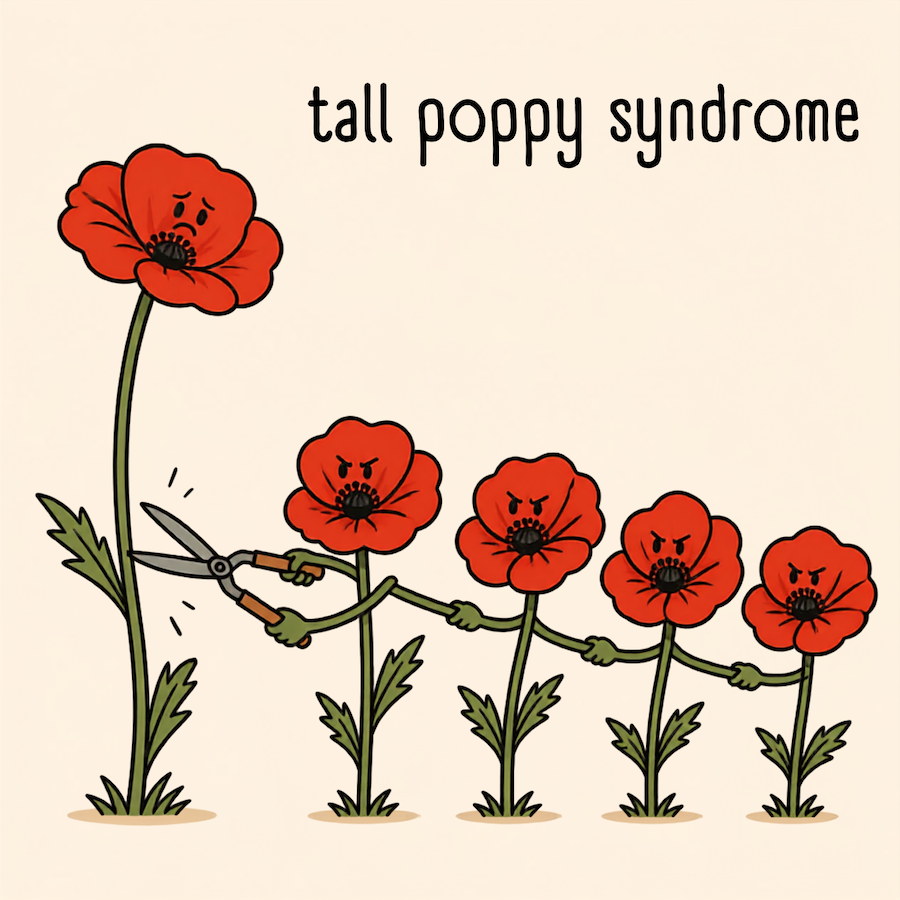
Dora had cut herself down to the height of everyone around her. But she was never only a tall poppy. She is one of the brightest, most colorful flowers in the garden, and she needed permission to be unapologetically that again.
She didn't come back quickly, and she didn't come back entirely on her own. She came back the way all my clients come back, through persistent, consistent, masterful coaching conversations, week after week, until the reminders took hold and the permission became her own rather than something I was extending to her. Slowly, she stopped managing her height. She began saying yes to fun, enjoyment, and all the things that make her feel alive. She let her standards be standards again, without the apology.
She's everything she ever was, and more. More powerful, more discerning, more creative, now integrated with the kind of wisdom and confidence that only this work of self-expansion produces. The woman we drew back out has all the qualities of the old Dora, plus the hard-won steadiness of someone who chose herself on purpose.
If there's a poppy in you that you've been quietly trimming to keep from standing out, let Dora's story be your permission to stop cutting. And if you can't yet give yourself that permission, that's what this work is for. Sometimes we need someone to see us forensically and remind us until we remember on our own.
Photo Credit: Visionary Women