My Most Expensive Lesson at Gucci
Want to listen to the article instead? Tune into Spotify.
What if becoming more knowledgeable doesn't lead to more fulfillment and success in life?
How would we live differently if we believed that? Would we consume less content, read fewer books, and pay less attention to experts? That seems like the natural result of such a belief.
But seriously, who would want that? And what kind of Life Coach would recommend it?
The kind writing this blog. The kind who has been a devoted pilgrim on the never-ending path of knowledge, and who came to understand, over time, that knowledge and wisdom are not the same thing, and that it's only wisdom that unlocks that sense of actual fulfillment we are all striving for.
I'm blessed to work with clients who are all, and I mean every single one, extraordinarily knowledgeable about so many different subjects. I'm often challenged to keep our conversations limited to what's useful for them, rather than what's wildly interesting to both of us. Their abundance of knowledge and my endless curiosity make a distracting combination, one I've had to learn to manage inside a professional conversation.
So, having gained all this valuable information, why are so many of us not at least as content with our lives as we are knowledgeable?
The answer is counterintuitive and not what we learn in school, where the highest goal is accumulating knowledge.
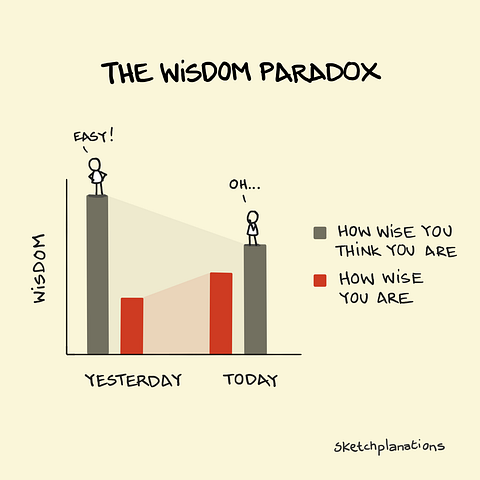
The truth is that information does not automatically lead to transformation.
Knowledge is what we get from consuming information. Transformation is an internal shift, and it rides with wisdom, a very different companion than its younger sibling, knowledge.
Here's the distinction I keep returning to.
Knowledge tells you what is. But wisdom tells you what matters, and when, and for whom.
A brilliant person can hold every relevant fact about a decision and still not know what to do, because the not-knowing was never an information problem.
Knowledge is answers. Wisdom is knowing the important question beneath the one being presented.
Let me show you what I mean, using the most expensive lesson I ever learned.
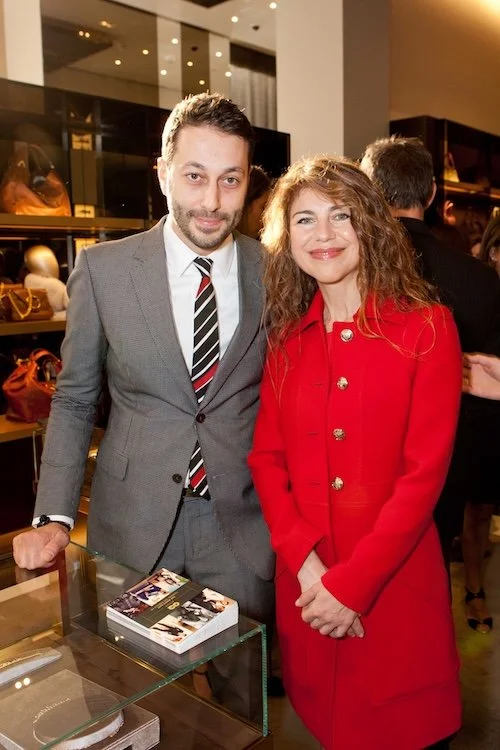
In what feels like a lifetime ago, I was the first Director of Client Relations for Gucci in America. I know I was the first person in that role because the position didn't exist at any luxury brand in those years. The US CEO, who had been my boss at another fashion house, knew my skills in developing teams and clients and created the role specifically for me. That kind of thing could never happen now in the conglomerate-driven world of luxury fashion.
Trouble was waiting for me from day one. Even though I was on salary and not commission, I met resistance everywhere. The salespeople feared they'd lose the client relationship to me, even if they ended up making more money. The managers, whom I didn't report to, suspected I was a Trojan horse sent to take their jobs.
If a client came to me today in that exact situation, I would coach her to slow down. Develop a real relationship with each stakeholder, one at a time. Relationships built on bringing value and cultivating trust. But that's my hard-earned wisdom speaking from the rearview mirror.
What I actually did was complain to the CEO who had created the position for me. Instead of taking radical responsibility for the results I'd committed to, I wanted someone bigger and stronger to clear the obstacles out of my way. I had a great deal of information. That's why I was hired. What I didn't have was sufficient wisdom, which is why, when my boss was let go, so was I!
And here's the part that took me years to see.
My whole strategy was addition. I believed that if I just increased the sales, put more money in the salespeople's pockets, grew the store's volume, and worked longer hours, the resistance would dissolve on its own. I kept trying to add my way out of the problem. More doing, more pushing, more convincing.
The situation was asking for subtraction. Less pushing, less convincing, less proving I belonged. More caring, more listening, more of the deeper, non-financial value I could have brought to each person if I'd stopped trying to win them over long enough to understand them. I had all the knowledge the role required. I was missing the wisdom the role required.
Knowledge and wisdom are not the same, and no amount of the first adds up to the second.
That's been the core lesson for me and what I help my clients first understand intellectually and then cultivate internally. But a few other distinctions have clarified over the years, and they're worth naming.
Knowledge is gained by consuming information. Wisdom is gained by testing that information through action, usually public action, the kind that carries a real risk of embarrassment and failure. Which is why so often it’s simple courage, not more information, that unlocks our growth.
Knowledge has us talking more. Wisdom has us listening more.
Knowledge is exciting to acquire and makes us feel immediately smarter. Wisdom is the quiet gift that arrives afterward, once we've lived through the challenge and the pain.
And the one my Gucci story taught me: knowledge is about addition. Wisdom is about subtraction.
Lao Tzu said it long before I learned it the hard way. "To attain knowledge, add something every day. To attain wisdom, subtract something every day."
So if you're an accomplished, knowledgeable person who has quietly wondered why all that information hasn't delivered the fulfillment it seemed to promise, I'd offer you the question I had to grow into.
What are you finally ready to subtract?
Photo Credits:
Drew Altizer Photography | GUCCI + GQ Host Private Cocktail Party Featuring the Men's Spring Summer 2012 Suiting Collection, May 2012
If something in you is craving a little more clarity—about where your life is working and where it's quietly asking for attention—I'd love for you to take the Life Audit.
It's free, it takes about ten minutes, and people are often surprised by what they discover.
Once you complete the audit, I'll share with you three handpicked reads from my journal (or you can listen to their audio versions)—chosen specifically for the area that needs your attention the most at this time.