“Time Will Honor Your Greatness.” — Shelly-Ann Fraser-Pryce

Want to listen to the article instead? Tune into Spotify.
I heard Shelly-Ann Fraser-Pryce say five words recently that I haven't been able to put down.
She's the Jamaican sprinter, the most decorated 100-meter runner in history. She was on Mel Robbins' podcast, talking about doubt, age, and the belief that your best days are behind you. And in the middle of it, she said this:
"Time will honor your greatness."
I wrote it on a card. I've carried it around. And the more I sat with it, the more I realized I'd almost misunderstood it, because there's a lazy way to hear that line and a true way, and the difference is the entire point.
The lazy way to hear it is passive. Just keep going, and time, all on its own, will eventually reward you. Outlast your doubts. Be patient. The years will vindicate you. It's a comforting idea, but it's wrong—and it isn't what she means.
Listen to how she actually said it. "Time, that's all you need, time. For a lot of persons, they look at the clock, and they think, 'I don't have enough time.' But for the persons who's chasing excellence and chasing growth, it's never too late when you look at the clock." And then, after listing everything the world said she was too old or too young or too inexperienced to do: "So when I say all of that, I say time. You have time. You have to show up."
There it is. You have time. You have to show up. Time is the given. Showing up is the condition.
She is not saying time honors you. She is saying time honors your greatness, and greatness is something you build inside the time, through effort, through intention, through showing up when you'd rather not. Time is the container.
What fills it is the work. Empty time honors nothing.
That distinction matters more than it sounds, because most of us treat time as passive in both directions. When we're afraid, we treat it as a thief, running out on us. When we're hopeful, we treat it as a savior, bound to deliver if we just have the patience to wait. Fraser-Pryce rejects both. Time is neither stealing from you nor saving you. It's simply the ground. What grows there is up to what you plant.
She proved it within a single year. In 2007 she went to the World Championships in Osaka as a reserve, twenty years old, running only in the relay heats, in her own words, “just happy to be there”. The year before, she'd finished fifth at her national championships. One year later, in 2008, she won Olympic gold in the 100 meters and became the first Caribbean woman ever to do it. "A lot can change in a year," she says. But notice what changed. Not the amount of time she had. What she did with it. "One year of being intentional," she told Mel Robbins, "got me an Olympic gold medal. Just one year."
One year of intention. That's the active version of time, and it's the one worth believing in.
I think about this constantly, because so many of the women I coach arrive with an audacious goal in one hand and a quiet apology in the other. They want to start the company, write the book, change careers, train for the thing, rebuild the relationship. And almost in the same breath, they explain why it's probably too late. They're past their age. They missed the window. The good years are behind them. They say it gently, as if they've made peace with it, but I can hear that they haven't.
What I want them to understand is exactly Fraser-Pryce's distinction. Whether time honors anything depends on what you pour into it.
There's one more piece of this that keeps it honest, and it's the part I love most. Fraser-Pryce doesn't promise the outcome. Asked about chasing a fifth Olympics, she said, "If it doesn't happen, I'll be satisfied knowing that I gave 100% towards that effort." Her peace isn't attached to the medal. It's attached to the effort. She gave everything to the time she had, and that, win or lose, is what she gets to stand on.
This is why she says honor and not reward. A reward can be withheld. You can give a year everything you have and not get the gold. That happened to her at her last Olympics, where she came up without a win. But honor is different. Honor is the recognition that something was real, whether or not it came with a prize. The woman who finally writes the book has written a book, whether or not it sells. The one who trains for the race has become someone who trains, whether or not she places. The greatness was in the intention and the showing up, and time honors that even when the scoreboard doesn't.
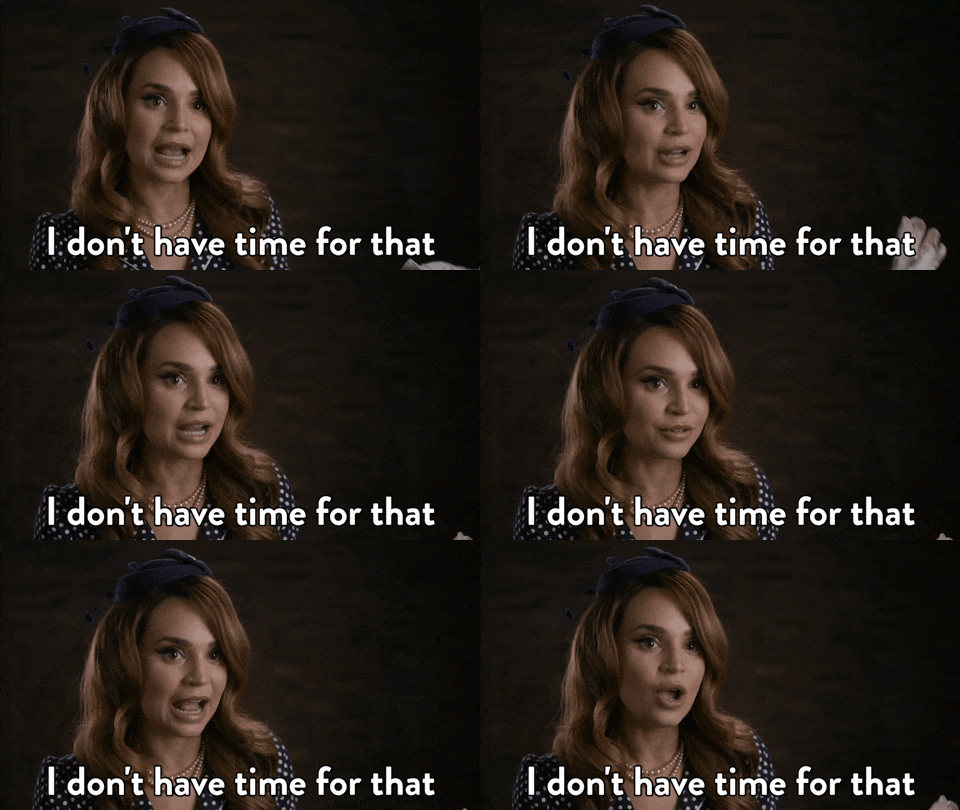
I wrote recently about the phrase "I don't have time for that," and how it's almost never about time at all. It's about whether we believe we're worth the investment. Fraser-Pryce is standing on the other side of that same coin, and she even names it: "a lot of persons look at the clock and think, I don't have enough time." Her answer is that you do have the time. What you lack is not the hours. It's the decision to fill them with everything you've got.
So if you're holding an audacious goal in one hand and a quiet apology in the other, let me take the apology from you.
You are not too late. The years ahead of you are not running out on your greatness, and they are not going to hand it to you either. They are the ground. Show up, give it your intention, spend it at 100%, and let time do the one thing it reliably does.
It will honor what you build in it.
Tell me, what is that audacious goal you've been apologizing for?

If something in you is craving a little more clarity—about where your life is working and where it's quietly asking for attention—I'd love for you to take the Life Audit.
It's free, it takes about ten minutes, and people are often surprised by what they discover.
Once you complete the audit, I'll share with you three handpicked reads from my journal (or you can listen to their audio versions)—chosen specifically for the area that needs your attention the most at this time.