Want to listen to the article instead? Tune into Spotify.
The Jewish New Year is almost upon us.
And the recurring refrain in my mind is, "Phew. We made it!"
I don't know what this year cost each of you, and I'm not going to pretend I do. But I know we're here.
We took some dodgy turns and weren't sure we could handle the curves.
We were scared and anxious and wanted to zone out with Netflix.
We fell, got back up, and lived to tell.
We were embarrassed and ashamed and certain that everyone could see we were faking it and nowhere near making it.
We went to sleep with tears and fears and woke up to put one foot in front of the other again.
We loved and gave, sometimes without conditions and sometimes hoping it would come back to us.
We kept score while telling ourselves we were being generous.
We said yes when we meant no, and then resented the person who asked.
We were short with those who could least afford it and gracious with those who could most.
We let a friendship go quiet because repairing it would have meant going first.
We told a version of the story that made us look better, and we knew we were doing it.
We meant to call. We didn't call.
We thought we were alone, which wasn't untrue, until we caught a glimpse of someone else's inner life and understood that we're no less alone than the women we admire and envy.
We tried hard and failed more often than we like to admit. Coaches and mentors told us it wasn't failure; it was learning. It hurt like hell anyway.
We were inspired to become better versions of ourselves. Sometimes that was easy, and we felt like a million dollars. More often than not, we arrived at our best and saw how far we still had to go.
Still, we made it.
Making it is worth something. But surviving the year is not the same as being honest about it, and the second is harder than the first.
I've spent a decade telling women that failure is information, and I genuinely believe it. I've watched it free clients who were so frightened of getting things wrong that they stopped moving altogether.
You know that feeling of being frozen, of being stuck? Reframing is one of the most powerful and liberating tools we have for managing our wayward and lost minds, and moving from stuckness to action.
But I'm a graduate student in Jewish Studies now, and the texts I sit with all week make a different demand of me in Elul, the month leading up to the Jewish New Year. There was a moment in my studies when I was faced with Maimonides and his clear requirements for us. No, his clear requirement of me, personally.
He opens the laws of teshuvah with confession, and he means it literally. Out loud. In words. Not reframed, not softened into a learning opportunity, not processed into something that reflects better on the person doing the processing.
"Say what you did," demands the Rambam.
I put the book down. I noticed I was holding my breath. I felt the weight of his wisdom in my body before I could accept it in my mind, and in the quiet, honest part of my soul, there was simply nothing to reframe.
So I've stopped trying to make my two instructions work together, the useful reframing and the absolutely honest naming. And once I stopped forcing them, I saw they were never really in conflict. They're tools for two different conditions, and the trouble only comes from using one when the moment calls for the other.
You see, reframing keeps you moving. It's what you need when you're paralyzed, and the only thing that matters is taking the next step. Naming is what you need when you're moving fine and have been for years, and the thing you're avoiding isn't action but honesty, vulnerability, and connection.
Most of the women I work with are not paralyzed. They're extremely capable, and capable people can talk about themselves kindly for years without ever once telling the plain truth. Elul is the month that asks us to set that kindness down for a while and say the plain thing.
And the tradition doesn't let this stay private. The Mishnah is direct: Yom Kippur clears what's between a person and God, but what's between you and another person stays uncleared until you go to that person and make it right. You have to go.
So before Rosh Hashanah, I'm doing the accounting, rather than setting resolutions. An honest list of what I actually did this year, in plain words, without the language that makes it sound better than it was.
Then I'll pick one name off that list and go first.
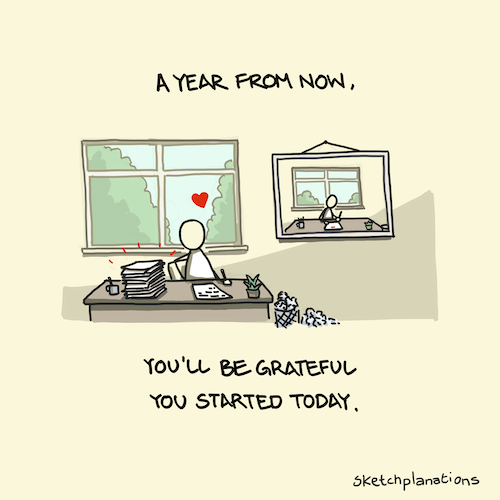
Photo credit: Sketchplanations