Want to listen to the article instead? Tune into Spotify.
Are you watching Dancing With the Stars? I am, for the first time in my life, and for one specific reason.
That reason is fast becoming known around the world by his first name alone, the way we say Madonna or Elvis. Ezra.
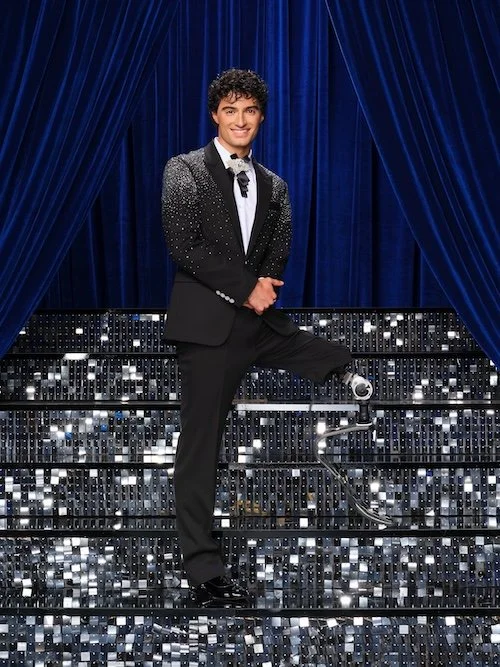
Ezra Frech is a 21-year-old above-the-knee amputee. He was born with most of his left leg missing—no knee, no fibula—and with one finger on his left hand. As a child, surgeons moved one of his toes to his hand so he’d have a working digit. He is also a two-time Paralympic gold medalist, a world champion, the first above-the-knee amputee to run Division I track, and, as of this season, the reason a woman who’s never watched this show is suddenly glued to it on a weeknight.
He is also, if you’ll indulge the coach in me, the clearest case study I’ve seen in years on how to build a successful life.
For the past decade, I’ve coached many young adults from Ezra’s generation. They come to me, ostensibly, to find their “purpose” and to learn how to do this thing called adulting. Almost without exception, they are highly educated and have been loved and supported from birth by parents who spared no expense on their growth.
So what’s the problem?
Somewhere along the way, many of them absorbed a strange message: they are broken in some emotional, mental, or cultural way, and being broken is a kind of credential.
I don’t know exactly how it started, and I’m certain it began with good intentions. We set out to acknowledge people’s pain and to reckon honestly with who was handed advantages and who wasn’t. That instinct was decent. But something warped on the way from intention to practice. We started treating woundedness as currency, and once a thing becomes currency, people compete for it. We built, without meaning to, a kind of trauma Olympics, where the fastest route to being seen was to prove how much you’d suffered.
I want to be careful here, because real pain is real, and some of these young people are genuinely struggling and deserve genuine help. My quarrel is not with them. It’s with a culture, and frankly a parenting style, that taught capable kids that their hardship was the most interesting thing about them.
Because look at what we did with the alternative. Instead of telling our kids the ordinary, durable truth—that you often won’t feel like doing hard things, that much of life won’t feel good, and that you have to do it anyway—we handed out participation medals. We got the note for extra time on the test. We argued down the teacher we decided was too tough on our delicate child. And we told ourselves that shielding them from every disappointment was what good parents do.
So it’s no accident that so many of us can’t look away from a young man who was, by the cruelest possible accounting, born with less. He is missing the parts the rest of us never think to be grateful for. And what does he do with that? He was taught, and now teaches the world, that lack does not get to write his story.
I knew of Ezra long before Dancing With the Stars introduced him to living rooms that had never heard his name. He was already a champion, already an advocate who’d been speaking in schools since he was a small boy. And in all that time, I have never once seen him trade on his disability to collect something extra. In the very situations where asking for the equivalent of “extra time” would have been more than fair, he instead did the brutally hard work it took to become an example of what is possible rather than a monument to what is missing.
This is a man who dances on a running blade, where a few centimeters of carbon meet the floor on every step, and there is almost no room for error, on a stage built for people with two feet. He could have led with his limitation. He leads with his craft.
I hope, and I pray, that Ezra sparks a revolution that is actually a return.
A return to being proud of ambition and hard work. Proud to make full use of every gift and advantage we’ve been blessed with instead of apologizing for it. And willing to spend less of our energy cataloging what we lack or weren’t born into, and more of it making something of what we were given, so that we become the kind of people who pull others upward.
That is what Ezra teaches, without ever giving a lesson. He just gets up, straps on the blade, and shows us.
Photo Credit: Ezra Frech & Dancing with the Stars