The Question That Changes Everything
Want to listen to the article instead? Tune into Spotify.
"How do I make it happen?"
This was the question I asked myself for decades. It was the engine of my life.
I was raised to be independent, resourceful, and high-achieving. Bars were not set low in my family. I embraced that perspective and elevated it further—because for whatever reason, I felt compelled to exceed what others considered "good enough."
And it worked. For a long time, it worked beautifully.
But somewhere along the way, the question became a trap. It wasn't just about achievement anymore. It was about proving that I could do it alone. If I couldn't accomplish something entirely by myself, did it really count? Did I deserve the credit? The pride? The sense of worth?
I didn't realize it at the time, but I had built an identity around not needing help. Needing help meant weakness. Asking for help meant I wasn't capable enough.
The whole point was to figure it out on my own.
Until I couldn't.
In my 40s, I hit a wall. The question I had relied on for so long—"How do I make it happen?"—stopped producing answers. I'd ask, and all I'd hear in return was silence. Sometimes mean, judgmental voices. But mostly silence.
I was exhausted. Confused. Successful by every external measure, but privately unraveling.
It took me a while to understand that I wasn't failing at finding the answer. I was asking the wrong question.
David Whyte captures this beautifully: "Help is strangely something we want to do without, as if the very idea disturbs and blurs the boundaries of our individual endeavors—as if we cannot face how much we need in order to go on."
That was me. The very idea of needing help disturbed me. It blurred the boundaries of who I thought I was: the one who figures it out, the one who handles it, the one who doesn't need what other people need.
But that identity was costing me everything.
Marshall Goldsmith's book What Got You Here Won't Get You There gave me language for what I was experiencing. The very traits that had propelled my success—fierce independence, relentless resourcefulness, the refusal to ask for help—had become the obstacles to my next chapter. What once served me was now strangling me.
"But it worked so well, for so long!" my mind protested. "Why mess with a good thing?"
Because the results told the truth. I could no longer pretend the approach was working. The exhaustion was real. The emptiness was real. The sense that I was running on fumes while performing competence—that was real too.
Something had to change. And the change wasn't another strategy. It was a different question entirely.
Instead of "How do I make it happen?" I started asking, "Who do I need to talk to?"
This shift sounds simple. It wasn't. It required me to dismantle decades of conditioning. It required me to admit that I had blind spots—that I didn't notice what I didn't notice.
Shane Parrish puts it perfectly: "The biggest barrier to learning from contact with reality is ourselves. It's hard to understand a system we are part of because we have blind spots."
I was the system. I was inside it. And I needed someone outside of it to help me see clearly.
So I got help. I hired an incredible Coach. I worked with therapists. I found mentors. Not because I was broken, but because I finally understood that isolation was the problem, not the solution.
And here's what I learned: very little of significance happens when we work alone. But with the right support, anything is possible!
I see this pattern constantly now in the women I coach. Accomplished, intelligent, capable women who have spent decades being the one everyone else relies on. They've built careers, raised families, managed households, led teams, solved problems—always solving problems. They've become so good at handling everything that they've forgotten how to ask for help. Or they never learned in the first place.
By the time they come to me, they're tired. Not just physically tired, but tired in their souls. Tired of carrying it all. Tired of performing strength. Tired of the isolation that comes with being "the capable one."
And almost always, underneath the exhaustion, there's a question they've been afraid to ask: Is it okay to need help?
Yes. It's more than okay. It's necessary.
The friends and family who love you cannot give you what a coach, therapist, or mentor can. Not because they don't care, but because they're inside the system with you. They have their own history, their own stake in your choices, their own vision of who you are and should be. A professional has no agenda except your clarity and your growth. That's a different kind of conversation entirely.
But before you find the right person to talk to, you have to release the belief that you should be figuring this out alone. That belief served you once. It doesn't anymore.
David Whyte again: "To ask for the right kind of help, and to feel that it is no less than our due—that in effect, we deserve both a visible and an invisible helping hand—may be an engine of transformation itself."
Read that again. Asking for help isn't a sign of failure. It may be the very engine of your transformation.
So let me ask you: What question have you been asking yourself? And is it still the right one?
If "How do I make it happen?" has stopped working—if the silence is getting louder, if the exhaustion is getting heavier, if the performance is getting harder to sustain—maybe it's time for a different question.
Who do I need to talk to?
The answer might change everything.
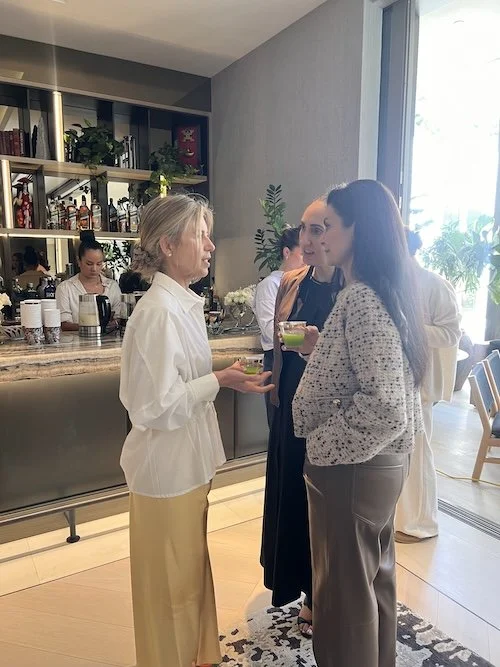
Photo: Visionary Women